
How to Package 1:1 Coaching in Kajabi (Using Backstage)
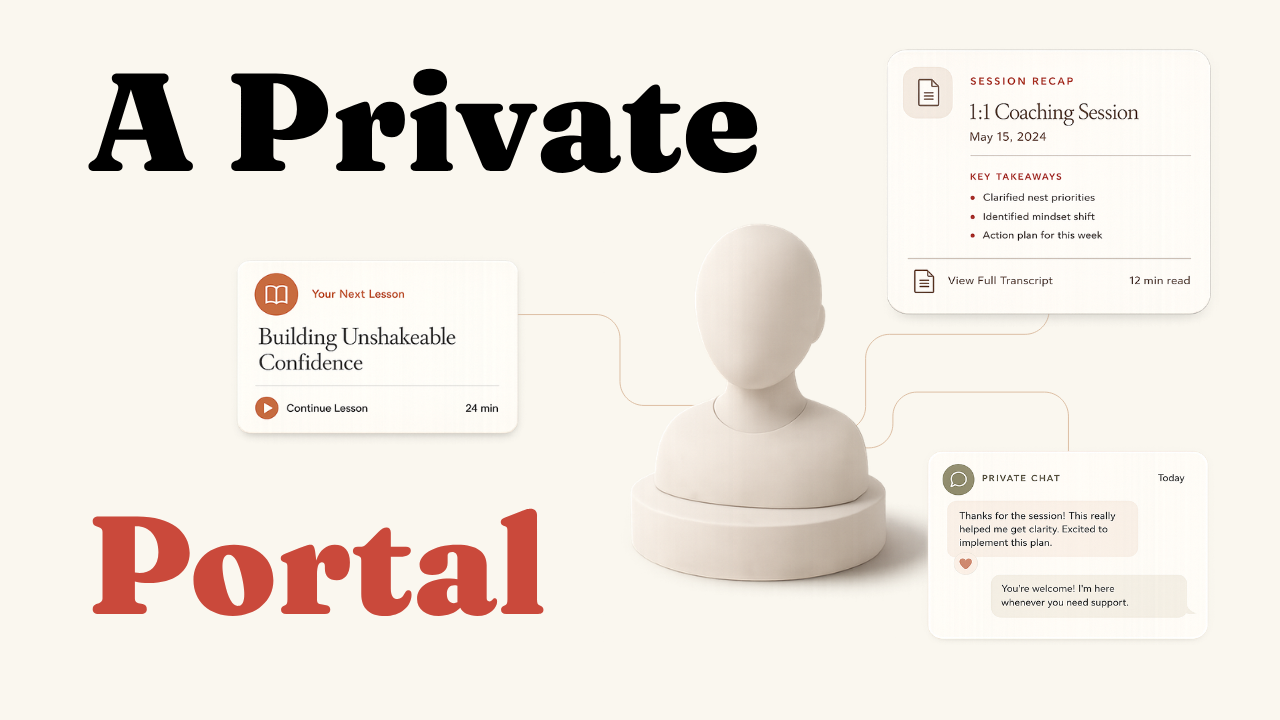
If you coach clients one-on-one or in small groups, you've probably run into this problem: you build a course, and clients either don't finish it or don't feel like it was built for them specifically. Backstage is Kajabi's answer to that gap — a private portal for each client, built from content you already have.
The content overlaps with your existing course. The packaging is what makes it feel personal — and that's what clients pay a premium for.
What a client actually sees
Each client logs into their own portal — not a shared course, a space that's theirs:
- Assignments and lessons, pulled from your existing content library and arranged around their specific goals
- Recorded sessions, automatically summarized so a client can pick up exactly where the last session left off
- Voice memo transcripts — record a short note between sessions, and the client gets both the audio and a clean written transcript
- Direct chat with you, in the same space as everything else
You're not starting from scratch
The core idea is reuse, not rebuild. You drop existing lessons into a client's specific path — the same material you already have, placed in a new context that fits that person's situation. This is the difference between a generic course and a program that feels personally built, without spending hours creating new content for every client.
Why this changes what you can charge
A shared course and a personalized coaching portal are two different products, even if much of the underlying content overlaps. Clients pay a premium for delivery that feels tailored to them — the same content, repackaged as a program built around their specific goals, justifies a materially higher price point than a self-paced course alone.
Where it fits into your existing offers
Backstage is built to bundle with any offer you already run — turning a $2,000-a-month coaching package into something built from content you've already created, rather than something you build from zero. If you're currently offering high-touch coaching manually (calls, email check-ins, ad hoc resources), this gives that relationship a structured home.
A quick fit-check before you set it up
Ask yourself:
- Do I already have 1:1 or small-group clients paying a premium rate?
- Am I currently repeating the same manual work (check-ins, resource-sharing) for each client?
- Do I have existing lesson content I could reuse across multiple client paths?
If you answered yes to at least two of these, Backstage is likely worth setting up. If your business is a single self-paced course with no ongoing client relationship, it adds complexity you don't need yet.
Final Thought
Backstage doesn't ask you to create new content — it asks you to reorganize what you already have around each client's specific path, then wraps it in recorded-session summaries and transcribed voice notes that keep the relationship moving between calls. For coaches charging premium rates, that packaging is often what justifies the price.
Thinking about building a course? Before you spend a year and $10,000 on it, read how The Launch Path works.