
How to Price Your Online Course (A Simple Framework)
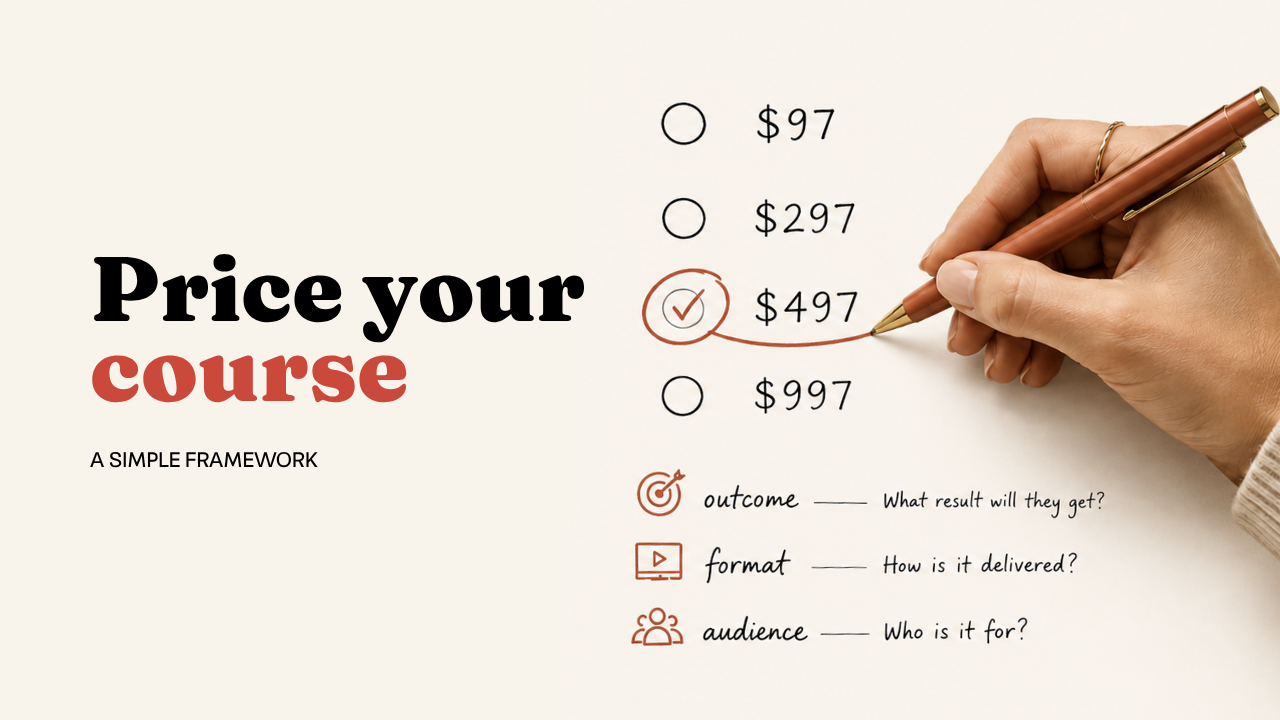
Pricing is one of the most common places we see course creators freeze up. Too low, and you undersell the transformation you're providing. Too high, and you scare off buyers who would have converted at a more realistic number.
Price the outcome. Never price the content.
Here's a framework that removes some of the guesswork.
Step 1: Price the outcome, not the content
The biggest pricing mistake is anchoring to how much content you have — number of videos, hours of footage, page count of a workbook. None of that is what a customer is actually buying. They're buying a specific outcome or transformation. A 3-hour course that solves an urgent, expensive problem can reasonably cost more than a 20-hour course delivering general knowledge.
Step 2: Match your price to the format
- Self-paced course, no direct access to you → lower price point, higher volume
- Course + community access → moderate premium over self-paced alone
- Course + live coaching or cohort-based delivery → significant premium, since your time is now part of the product
- Fully personalized coaching (like a Backstage-style portal) → highest price point, because delivery is built around one specific person
Match your price expectations to which of these you're actually building — not the price you've seen a competitor charge for a different format.
Step 3: Research what similar outcomes cost elsewhere
Look at adjacent solutions to the same problem — not just other courses, but consultants, agencies, or done-for-you services solving something similar. If a consultant charges $2,000 for a result your course delivers in a more scalable way, that's useful context for where your price could sit.
Step 4: Build in room for bumps and upsells
Rather than trying to capture all the value in one price point, consider a lower core price with relevant order bumps or upsells for customers who want more. This often converts better than a single high price, while still capturing extra revenue from buyers ready to spend more.
Step 5: Test, don't guess forever
Pick a price based on the steps above, launch, and give it real time — ideally a full sales cycle — before deciding it's wrong. Changing your price too early, based on a handful of early responses, makes it hard to tell if the issue was the price or something else entirely (the offer, the page, the traffic source).
A quick sanity check before you publish your price
Say your price out loud, followed immediately by what the customer gets. If it sounds lopsided either way — too cheap for the transformation, or too steep for the format — that gut reaction is usually a more reliable signal than staring at the number on a page.
Final Thought
Price the transformation, not the content. Match your price to the format you're actually delivering, look at what similar outcomes cost outside the course world, and give a price real time to prove itself before changing it.