
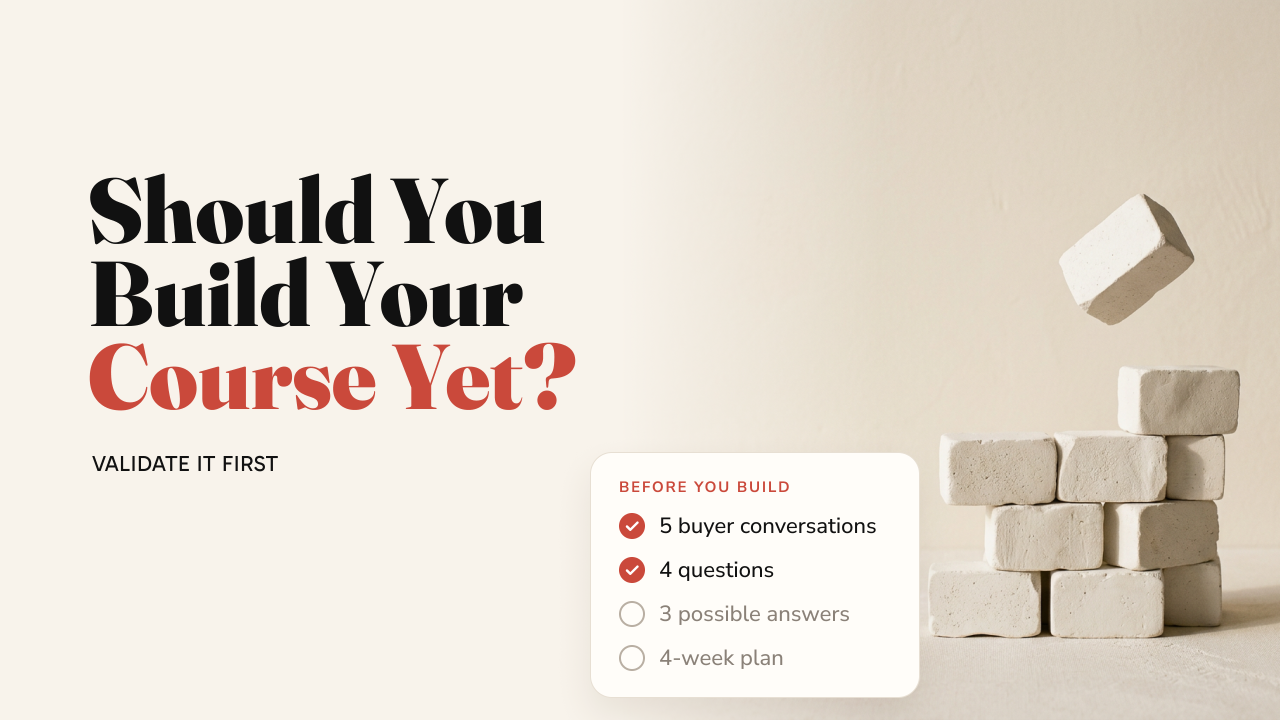
Should You Build Your Course Yet?
You have a course idea. People already ask you about the thing you know, and you have started to picture the lessons, the site and the launch.
Here is the short answer to "should I build it now?": not until five people who have the problem have talked to you about it, and three of them have shown they would pay. That check takes about four weeks. Skipping it often costs a year.
We build course sites for a living. The most expensive mistake we see is not a bad design or the wrong platform. It is building first and asking second.
This guide covers what the check looks like, the four questions it answers, the three answers you can get, and how to run it yourself, week by week.
Why does one course sell and another, built with the same effort, does not?
In most cases we see, the difference is the first step, not the effort or the content. Here is the pattern, shown as one idea taken down two roads. It is an illustration, not one client's numbers, but anyone who has built a course will recognize both versions.
The idea: a six-week program for people who have just been promoted to their first manager job. The owner has managed teams for ten years and people already ask her for advice.
The road where she builds first
She spends the spring recording 40 lessons, buys a microphone and lighting, pays for a site and a year of a course platform. By September she has spent several thousand dollars and most of her evenings since March.
She launches with an email to her list and a week of posts. A handful of people buy, mostly former colleagues. After the launch, the sales stop.
Nothing about the course was bad. The lessons were clear and the site worked. The problem was that nobody had been asked whether they wanted this thing, in this form, at this price.
The road where she asks first
She spends four weeks instead. She talks to five new managers and hears the same thing from four of them: they do not want 40 videos, they want someone to ask when a hard conversation is coming up on Thursday.
So she offers six weeks of small-group calls with a founding price and a start date. Three people pay. She records only the lessons those three actually need, and the second round sells to people the first group sends her.
What actually separated the two roads
The order. On the second road she found out what buyers wanted while it was still cheap to change the plan. On the first she found out after the money and the evenings were spent.
This is the pattern behind most of the courses we see stall, and we cover the other causes in why some courses get built and never sell.
What does it mean to validate a course idea?
It means two things: five real conversations with people who have the problem now, and three founding buyers who pay before the course exists. Not a survey, not a poll, not a waitlist.
Why don't surveys and waitlists count?
Because saying yes costs nothing. A poll where 80 people tap "I'd buy this" tells you that 80 people had a free second. A waitlist with 200 emails tells you 200 people were curious enough to type their address.
Neither tells you whether anyone will pay $300 or $1,500 for the result. People are generous with interest and careful with money, and only money answers the question you are asking.
Why five conversations?
Five is roughly where patterns start to repeat. By the fifth talk you will hear the same frustration in nearly the same words, or you will notice that everyone describes a different problem. Both are useful.
The five should be people who have the problem today, not friends being kind. A friend says "I love it." A buyer says "I tried two apps for this and quit both in a week." That second sentence is what you are looking for. We go through who to ask and what to ask in five conversations, not a survey.
Why three founding buyers?
A conversation shows the problem is real. A payment shows it is worth money to someone. Three paid seats at a founding price, for a program with a start date, is the pass mark we use for a group course.
The number shifts with the shape of the offer. For high-ticket 1:1 work, two buyers is enough. For a membership, aim for five, because memberships live or die on numbers. How to get those first buyers without a finished course is the subject of the Sell guide, sell your first seats before the course exists.
What do you need to know before you build anything?
Four things: who it is for, what changes for them, whether they would pay, and how they will find you. If you can answer all four with evidence rather than hope, you are ready to build. If one is blank, that is where the next two weeks go.
Who exactly is it for?
Name a person you could find this week, not a demographic. "Women who want to be healthier" is a market. "Nurses in their first two years of night shifts who have gained weight since they started" is a person, and you can probably name three of them.
The test: could you list five people who fit the description right now? If not, the description is still too wide.
What changes for them?
Write it as one sentence: from where they are, to where they will be, by when. "From dreading the 3am break room to a plan that fits a 12-hour shift, in six weeks." If the sentence lists four outcomes, pick one. If the outcome is a feeling ("more confident"), ask what they would do differently once they had it.
Would they pay for it?
The best sign is that they already pay for something that tries to fix this: a book, an app, a coach, a gym plan they abandoned. Someone who has spent $200 on the problem and is still stuck is a buyer. Someone who has never spent a cent on it usually is not, however much they agree it matters.
How will they find you?
Name the place where at least 250 of these people already are, and say how you get in front of them. "My list of 300 past clients" is an answer. "A Facebook group of 4,000 nurses I have posted in for two years" is an answer. "I will post on Instagram" is a plan to hope.
This one matters even when the other three are strong. A good course that nobody hears about sells the same as a bad one.
What answers can the check give you?
Three: build it, not yet, or change the idea. Each one saves you something, so each one counts as a good result.
Build it
Five conversations described the same problem, at least three people paid, and you know where the next 50 buyers will come from. Now spending money on a site, recording and launch makes sense, because you are building for people who already said yes.
The founding buyers also tell you what to build first. If all three signed up for the live calls and none asked about the video library, the video library can wait.
Not yet
The problem is real, but something is missing: you could only reach two people, or nobody would commit to a date. This is usually one or two conversations away, not a year. We describe the common versions in signs you are not ready to build yet.
"Not yet" is the answer people fear most, and it is often the cheapest one. Finding a gap in week three costs three weeks. Finding it after launch costs the launch.
Change the idea
The conversations point somewhere slightly different from where you started. Your knowledge is fine. The shape, the audience or the promise needs to move.
A common example: someone plans a self-paced course, and all five people say they would rather have six weeks of live calls with a small group. Same expertise, different shape, and now there is a price people will pay. Another: the problem is real for a narrower group than planned. That is usually easier to sell to, and there is more on narrowing in pick the first thing to sell.
What does it cost to skip this step?
Usually a year of evenings, a few thousand dollars, and something harder to measure: the willingness to change course once you have spent all that.
The money
A course platform runs from $0 to $400 a month. Recording gear runs from $0 to $1,500. Getting the site built runs from about $100 for a template to $1,500 to $5,000 for a freelancer. A first launch with ads can add up to $3,000.
None of those numbers is outrageous on its own. Together, spent before anyone has said yes, they add up to the price of a used car for a test you could have run with a calendar and a phone. The full breakdown is in what it really costs to launch a course.
The time
The money is the smaller part. Recording, writing, setup and launch typically take months of evenings and weekends, around a job or a client list. Eight hours a week for nine months is close to 300 hours, and that is time not spent on the work that already pays you.
The sunk-cost trap
This is where most people lose a year. After six months and $4,000, a quiet launch does not feel like information. It feels like a verdict, and the natural response is to add more: another module, a new sales page, a few more weeks of posting.
The question "did anyone want this?" gets harder to ask the more you have spent. Asking it in week two, when the answer costs nothing to act on, is the whole point.
How do you run the check yourself in four weeks?
One focus a week, about three to four hours each. You need a document, a calendar and, by the last week, a way to take a payment. You do not need a website.
Week 1: who and what changes
Write the one-sentence description of who it is for and the from-to sentence for what changes. Then list 15 people who fit the description and who you can reach directly: past clients, people in groups you are already in, people who have asked you about this before.
Fifteen names gets you five conversations, because some will not reply and some will not have time. Send short personal messages asking for 20 minutes to hear how they deal with the problem. Do not mention a course yet.
Week 2: five conversations
Have the five talks. Ask about the last time the problem cost them something, what they have already tried, and what they spent on it. Listen more than you talk, and do not pitch.
Write down what they said in their own words, right after each call. A line like "I bought a meal plan and stopped on day four because nothing fit a night shift" is worth more than any summary you write later.
Week 3: the numbers
Look at three alternatives your five people mentioned or would find, and what each costs. Then work out the arithmetic: if you want $6,000 from a first round at $600, you need 10 buyers. If roughly one in ten people who hear about it buys, you need to reach about 100 of the right people.
Compare that to the place you named in the fourth question. If you can reach 300 of them, the math works. If you can reach 40, it does not yet, and you know why.
Week 4: the ask and the decision
Go back to the people who described the problem most clearly and make a real offer: a start date, a founding price 25 to 40 percent below what you would charge later, and a cap of 8 to 15 seats. A one-page document and a payment link are enough.
Count who pays. Three for a group program is a build. One or two is usually not yet. None, with five clear conversations behind it, usually means the shape or the promise needs to change, and the conversations tell you which. Then write down your decision and the reason, so you can stand behind it a month from now.
Where does The Launch Path fit?
It is the same four weeks, with us in the room. Stage 1 of The Launch Path is called Decide: a small group, a short lesson each week, four live calls, and five real conversations with potential buyers. You leave with a one-page decision: build it, change it, or not yet.
We built it because so many people come to us for a Kajabi site before they are ready, and the honest answer is often "not yet." Nothing gets built during those four weeks, and you do not need Kajabi to take part. If the idea passes, there are later stages for the offer, the build and what comes after launch. You can stop after any of them.
The first group starts on January 5 and has 15 seats. The price is $1,000, with a founding price of $700 from December 14 to December 31. If you are not sure the program is the right step yet, take the quiz first.
Frequently asked questions
Do I need an audience before I validate my idea?
No. Five conversations can come from past clients, colleagues, or a group you already belong to. An audience matters later, when you sell to strangers, and only if the idea passes.
Can I talk to friends?
Ask friends for introductions instead. Friends want to be kind, so they agree with everything. Someone a friend introduces you to will tell you what they actually tried and what it cost.
What if I add a price question to my survey?
It helps a little and proves very little. Choosing "$300" on a form costs nothing. Paying $300 is the only answer that settles it.
I already built the course. Is it too late?
No, you have something concrete to test. Run the same four weeks with the course as the offer. Some people learn they should keep going, others that the shape or price needs to change before they spend more.
How long does "not yet" usually last?
Weeks, in most cases we see. It is usually one missing piece, such as two more conversations or a clearer promise, not a year of preparation.
How much time does the check take?
About three to four hours a week for four weeks. Most of that is the conversations and writing down what people said.
What should you do this week?
Write down the names of five people who have the problem right now. Not a market, not a follower count, five names. If that takes ten minutes, you are closer than you think. If it takes all week, you have just learned the most useful thing in this guide, and it cost you nothing.
Thinking about building a course? Before you spend a year and $10,000 on it, read how The Launch Path works.