
How to Tell If Your Course Idea Will Sell: Five Conversations, Not a Survey
You want to know whether people will buy your course before you spend months making it. That is the right question, and the usual tools for answering it, a survey or a poll, give you the wrong answer.
What works is five conversations with people who have the problem right now. This post covers who to talk to, the six questions to ask in order, how to tell a real yes from a polite one, and what to do with what you hear. It is one part of a bigger check we describe in Should you build your course yet?
Why can't a survey tell you if your course will sell?
Because a survey asks people to predict what they will do, and people are bad at that. Answering "would you buy this?" costs nothing, so the answer is usually a kind yes.
Picture a survey sent to 300 people on your list. Sixty answer, and 45 tick "very interested." That feels like proof. Then the course opens, and three of the 45 buy. Nobody lied. Saying yes to an idea and paying for it are different decisions, made in different moods.
A conversation is different because you stop asking about the future. You ask about what already happened: the last time the problem came up, what it cost, what they tried. Past behavior is hard to fake, and it predicts buying far better than good intentions.
Who should you talk to?
Five people who have the problem now, not people who had it once or might have it someday. And not friends, unless they truly fit.
A useful filter: the problem has cost them something in the last three months. If your course is about pricing for freelance designers, you want designers who undercharged on a project this quarter, not designers who agree pricing is hard.
Where to find them:
- Past clients or students who came to you with this exact problem.
- People who have asked you about it in messages or comments.
- Members of a group or community you already belong to, where the problem comes up.
- Introductions from friends. Ask "who do you know who is dealing with this?" instead of asking the friend.
Write a list of about 15 names to get five conversations. Some will not reply, and some will not have time. A short personal message works best: you are looking into this problem and would like 20 minutes to hear how they deal with it. Do not mention a course.
What questions should you ask, and in what order?
Six questions, from the past to the present. Do not describe your course until the end, and only if they ask. The moment you pitch, people start being polite.
- "Tell me about the last time this came up. What happened?" You want a specific story with a date, not an opinion.
- "What did it cost you?" Time, money, a client, sleep. The answer tells you how painful the problem is.
- "What have you tried to fix it?" Books, apps, courses, a coach, asking a colleague. People who have tried nothing are rarely buyers.
- "What did you spend on that, and why did you stop?" This shows what they already pay for this problem, and what the existing options miss.
- "If this were solved, what would be different in a normal week?" Their answer is the outcome your course should promise, in their words.
- "If someone offered help with this, what would make you say no?" You hear the objections now, before they appear on your sales page.
Write down their exact words right after the call. "I quoted $4,000 for a project that took twice as long, and resented every hour of it" is worth more than any summary you write later.
How do you tell a real yes from a polite no?
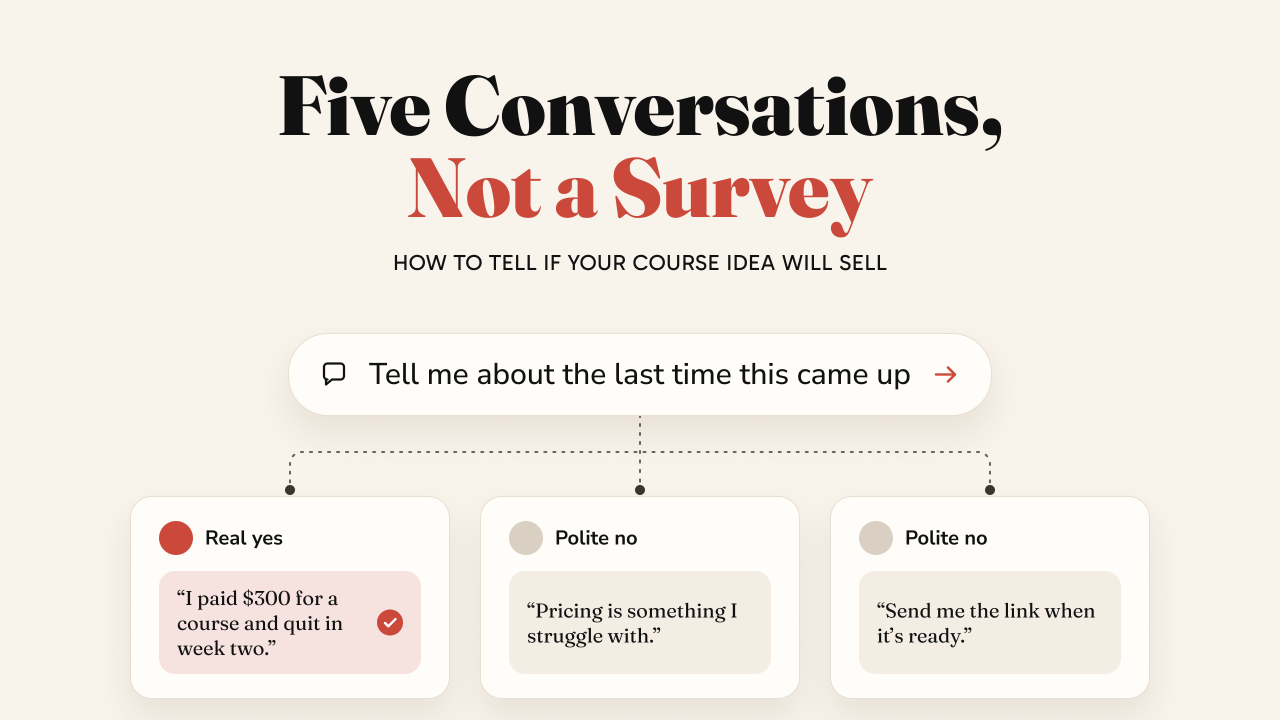
A real yes is specific and about the past. A polite no is general and about the future. Most people will not say no to your face, so you have to listen for the difference.
What a real yes sounds like:
- "Last month I spent two weekends redoing my rates sheet."
- "I paid $300 for a course on this and quit in week two."
- "When does it start? Can I bring a colleague?"
- "The worst part is the call where I have to say the number."
What a polite no sounds like:
- "Pricing is definitely something I struggle with."
- "I would totally take a course on that."
- "Send me the link when it's ready."
- "That sounds really useful for a lot of people."
The strongest sign is a question you did not prompt: when it starts, what it costs, whether it would work for their situation. When someone asks about the next step, they are already imagining buying.
What do you do with five answers?
Score each conversation on three questions, one point each, and add them up. The total is out of 15.
- Is the problem recent? It came up in the last three months. One point.
- Have they paid to fix it? Money or serious time spent on books, tools, courses or help. One point.
- Did they ask about the next step? Unprompted, they asked when, how much, or how to join. One point.
How to read the total:
- 10 to 15: the problem is real and people pay to solve it. Move on to asking for money, which we cover in how to sell your first seats before the course exists.
- 6 to 9: something is there, but one part is weak. Look at which point is missing most often; that is what to fix.
- 0 to 5: the conversations are telling you something important. See the next section.
The score is not science. Its job is to stop you from remembering the one enthusiastic call and forgetting the four lukewarm ones.
What if five conversations say no?
Then you have saved yourself months, and the conversations usually tell you why. There are three common reasons, and each points to a different fix.
You talked to the wrong people
If most of the five had the problem years ago, or never had it badly, the idea has not been tested yet. Find five people who had it this quarter and run the conversations again. This is the cheapest fix and the most common one.
The problem is real but not urgent
People nod, but nothing has gone wrong for them lately and nobody has spent money on it. A problem people put up with is hard to sell. Look for the moment when it becomes urgent, like a first big client, a promotion or a deadline, and talk to people at that moment.
They already solve it cheaply
Sometimes the answer to "what have you tried?" is a $15 app that works fine. Then the course has to promise something the cheap option cannot, or it needs a different shape, such as live help instead of videos.
None of these means the idea was wrong. It means you know what to change, and we go through the related warning signs in signs you are not ready to build yet.
Where do you start?
This week, write down 15 names and send five messages. You do not need a sales page, a logo or a platform to do it, just a list and a calendar. By the end of the fifth call, you will know more about whether your course will sell than any survey could tell you.
Thinking about building a course? Before you spend a year and $10,000 on it, read how The Launch Path works.